Better Intelligence Decisions When Evidence is Uncertain 🔗︎
An intelligence assessment overwhelmed by conflicting data. An investigation complicated by deception and synthetic media. An automated workflow that carries untested assumptions into the next stage of analysis.
Across security and intelligence work, analysts must make judgments with information that is fragmented, ambiguous, and constantly changing. More data can expand an investigation, but it does not automatically make a conclusion more reliable. The critical question is how analysts test what they think they know.
Structured Analytic Techniques (SATs) help make that reasoning explicit. They give investigators practical ways to challenge assumptions, examine competing explanations, and reduce the influence of cognitive bias and groupthink.
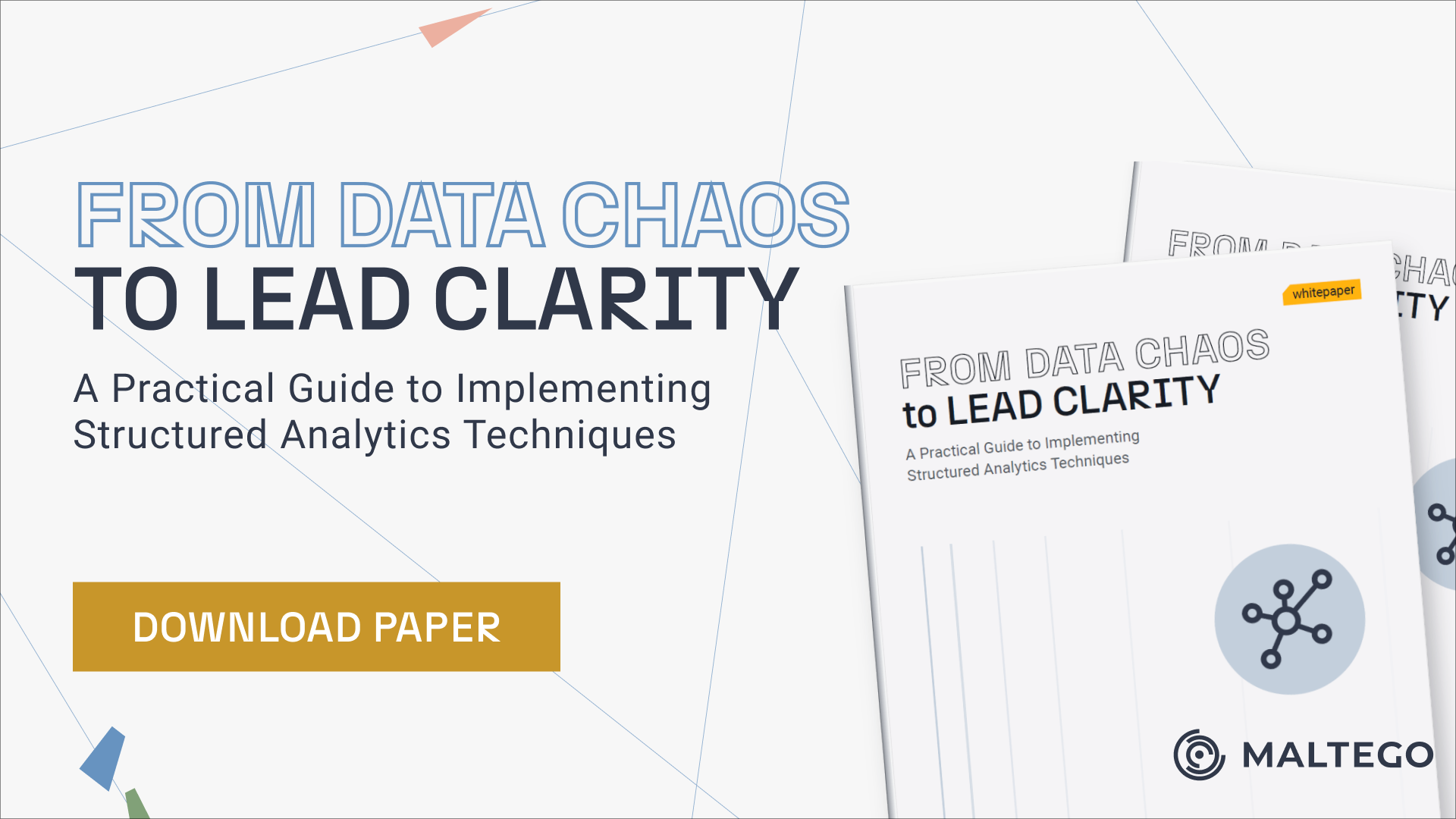
Our white paper explores how three techniques—Key Assumptions Check, Devil’s Advocacy, and Analysis of Competing Hypotheses—can support more defensible OSINT judgments and be integrated into Maltego Graph workflows.
When a Plausible Explanation Becomes a Blind Spot 🔗︎
An early hypothesis can help focus an investigation. It can also shape which information analysts collect, which relationships they notice, and which contradictions they dismiss.
A shared IP address may suggest a connection without establishing common control. Several reports may appear to corroborate a claim while ultimately relying on the same original source. A visually compelling graph may make an explanation feel stronger than the evidence supports.
Under pressure, these distinctions are easy to overlook. Once a team agrees on an explanation, challenging it can become harder. SATs introduce deliberate checkpoints: What are we assuming? What evidence would contradict our assessment? Could another explanation account for the same observations?
They cannot eliminate uncertainty or bias. They help teams recognize where those factors may be influencing a decision—and make that decision easier to review.
Download the White Paper 🔗︎
How do you put these techniques into practice without losing investigative momentum?
The white paper explains when and how to use Key Assumptions Check, Devil’s Advocacy, and Analysis of Competing Hypotheses. It also provides a step-by-step guide to integrating SATs into Maltego workflows and an operational evidence discipline framework for reviewing investigative claims.
You’ll learn how to:
- Apply structured techniques without losing investigative momentum.
- Integrate SATs into Maltego workflows.
- Combine tool-enabled discovery with structured human judgment.
Complete the form to download the white paper and explore practical ways to challenge assumptions, test alternative explanations, and build more defensible OSINT assessments.